Personal essay | November 2026
Preface: Who Are “They,” and What Is Being Right Worth?
Everybody likes being right. It feels good to discover an answer, recognize a mistake, or believe that we know something others have missed. But feeling right and being right are not the same thing. A person can believe something with all their heart and still be mistaken. We have all been certain before and discovered we were wrong. I certainly have.
Lately, I keep hearing a particular accusation: “They lied to us. They deceived us. Everything they taught us was wrong.”
Who are they? Our teachers? The authors of our textbooks? Scientists at universities? Archaeologists working in the field? Government officials? People who lived centuries before any of us? Those are very different people with different responsibilities, methods, and motives. Treating them as one mysterious, coordinated group makes the accusation easier to repeat and much harder to examine.
I also hear people who accept established scientific explanations dismissed as sheep, asleep, or not awake yet. But if someone rejects a scientific conclusion after watching a social-media personality explain why it is supposedly false, hasn't that person also relied on someone else's account? Who is actually following whom?
I'm not writing this to change anybody's mind about one particular conspiracy theory. I'm writing because I've watched confident claims replace careful questions, edited videos replace original sources, and disagreements over evidence take a real toll on relationships. I believe in questioning authority. I do not believe questioning something is the same as disproving it. And I believe the right to share an accusation comes with some responsibility to find out whether it's true.
1. What Were You Actually Taught?
When someone says everything we were taught was a lie, the first question I want to ask is simple: What, exactly, were they taught?
There is a difference between remembering that a teacher said Earth is spherical and understanding the geometry and observations that establish its shape. The same is true of gravity, the motion of Earth, and the difference between speed and acceleration. A scientific conclusion is not the same thing as the reasoning behind it.
Being taught something false, being given a correct conclusion without its explanation, and realizing later that the explanation was never understood are three different experiences.
Our education can absolutely be incomplete. Teachers may simplify material to suit a child's age. We forget things. Sometimes we memorize an answer and never learn how people discovered it. That is an argument for better teaching and lifelong curiosity, not automatic evidence of deception.
More than 2,000 years before NASA, the Greek scholar Eratosthenes used differences in shadows and geometry to estimate Earth's circumference. Modern historians still examine the details and limitations of his calculation. No modern space agency had to invent the idea of a spherical Earth. [1]
Someone standing on a beach may not notice a dramatic curve. That observation alone does not settle the planet's geometry. Earth's scale, the observer's height, and the predicted appearance of the horizon all matter.
Not understanding why something is true isn't proof that it is false.
2. The Explanation That Must Account for Everything
Consider the seemingly unrelated things we can observe: sunsets; the changing stars of January and July; constellations visible in one hemisphere but not the other; lunar phases and eclipses; tides; and the Sun remaining above the horizon for extended periods in the Arctic and Antarctic summers.
A rotating spherical Earth, tilted on its axis and orbiting the Sun, with the Moon orbiting Earth, helps explain these observations together. Gravity and the relative positions of Earth, Moon, and Sun help explain tides. Geometry explains why the night sky changes through the seasons and why the poles have periods of continuous daylight. And the model does more than explain the past: it predicts future observations with precision.
The Sun does not simply become smaller and smaller until it fades away at sunset. We can watch it disappear progressively below the horizon. We can predict the time of that event for a location. We can predict eclipses and periods of continuous polar daylight. Antarctic programs document the seasonal cycle, and tourists and researchers travel to the continent under environmental rules, not a universal prohibition on visiting. [2]
Popular flat-Earth maps, particularly the North-Pole-centered disk, do not provide one consistent, quantitative explanation for the full range of observations, including continuous daylight throughout the Antarctic summer and the geometry of southern-hemisphere skies.
And that is the point. An alternative explanation isn't established merely by identifying one observation that seems puzzling. It must explain the other observations too. Ideally, it should tell us in advance what we will see, where, and when.
A thirty-second video raising a question is not sufficient reason to abandon a model that consistently explains and predicts the observations.
3. Rotation, Gravity, and the Things We Mistake for Contradictions
I've heard people ask, “If Earth spins at a thousand miles an hour, why don't we feel it?” The approximate number refers to surface speed near the equator. Earth rotates only about fifteen degrees per hour relative to the Sun. Constant motion and changes in motion are different things; familiar physical systems can move rapidly without producing a continual sensation of speed.
A Jet Traveling at 500 Miles an Hour
Consider a commercial jet traveling about 500 miles per hour in smooth, straight-and-level flight. Inside, you can walk down the aisle normally. A flight attendant can pour a glass of water. If you toss a tennis ball straight up, it doesn't shoot toward the back of the cabin.
A fly could buzz around that cabin without being smashed against the rear wall. Why? Because the passengers, the tennis ball, the fly, the water, and the air inside the cabin are already moving along with the airplane.
When the tennis ball leaves your hand, it doesn't suddenly lose the forward velocity it already had. The fly doesn't have to fight a 500-mile-per-hour headwind inside the cabin. We can move around comfortably because we share the aircraft's motion. What we notice more readily are changes in that motion: acceleration, turbulence, or a turn.
Earth is not a jet flying in a straight line. A rotating planet does experience acceleration, and its rotation has measurable consequences, including the Coriolis effect. But we, the things around us, and much of the atmosphere already share Earth's rotational motion. There is no reason to expect objects to fly backward merely because the surface is moving.
An impressive-sounding speed is not proof that something is impossible. Before declaring that we have been deceived, shouldn't we first understand the difference between speed, acceleration, and motion relative to our surroundings?
I've also heard that atmospheric pressure supposedly requires a physical dome. But gravity allows a planet to retain an atmosphere, and pressure falls with altitude as the weight of overlying air decreases. Even a tall sealed container under gravity can have a pressure gradient. This is ordinary atmospheric physics, not a contradiction needing a hidden ceiling. [3]
Criticizing a simplified version of a scientific explanation encountered on Facebook is not the same as testing the underlying science. A meaningful challenge begins by understanding the actual claim.
4. Hurricanes: Why the Storms Turn
The paths of Atlantic hurricanes provide another example. Many tropical systems travel westward from the vicinity of Africa. Some approach the Caribbean or Gulf, while others curve north and northeast into the Atlantic. Trade winds, the subtropical high-pressure ridge, low-pressure troughs, and the prevailing westerlies help explain these patterns.
A hurricane is carried largely by its surrounding atmospheric flow, which is shaped by broad high- and low-pressure systems. A strong subtropical ridge can favor a westward track; a weakness in that ridge or an approaching trough can help turn a storm north and then northeast. Forecasters use measured winds, atmospheric pressure, and physical models to predict tracks, then compare those forecasts with observations. The evolving atmosphere explains both the predictive skill and the remaining uncertainty. [4]
In a 2024 study, researchers examined forecast errors involving Hurricanes Harvey, Irma, and Maria and showed how misrepresenting pressure systems such as the Bermuda High contributed to steering errors. This was a study of the physical forces that actually determine hurricane tracks, not a theory about someone controlling the storms. [5]
The science of hurricane steering is publicly documented. The accusation that an unnamed “they” is directing a particular storm requires separate evidence.
Tropical cyclones normally rotate counterclockwise north of the equator and clockwise south of it. Earth's rotation produces the Coriolis effect, whose sign changes between hemispheres and whose value goes to zero at the equator. That is one major reason tropical cyclones rarely develop very close to the equator.
It's not a magical wall that storms are physically forbidden to cross. An exceptional storm, Typhoon Vamei, formed near Singapore in December 2001 at about 1.5 degrees north. Its outer circulation reached across the equator, but its center remained north of it. Researchers studied the unusual wind pattern that made its formation possible. [6]
So rather than make an absolute claim about what nature “never” does, I want to ask something more useful: What physical explanation predicts the observed north-south difference in storm rotation, the rarity of equatorial formation, and the typical steering patterns? The rotating-Earth model does. Any alternative needs to show its work.
5. Satellites, GPS, Balloons, and the Visible Space Station
Some flat-Earth explanations dispense with satellites and attribute global positioning or communications to high-altitude balloons or cellular towers. But GPS has a specific, measurable technical basis.
A GPS receiver estimates its position by comparing extraordinarily precise timing signals transmitted by multiple orbiting satellites. The satellites are not parked motionless in the sky; their changing positions are known and tracked. GPS works even in many places without cell service, although your phone may need downloaded maps to make the coordinates useful. [7]
High-altitude balloons are real, and balloon-borne communications experiments are real. But that doesn't establish that a secret balloon network is responsible for the worldwide signals, timing, and geometry that GPS receivers actually measure. Where is the engineering evidence? How would a balloon system maintain global coverage? How would the winds, tracking, launches, replacement schedule, and communications be managed? How could we distinguish it from the measurable satellite system?
Then there is the International Space Station. During favorable passes it is visible to the naked eye as a bright moving point. Amateur observers with suitable equipment have photographed its recognizable structure, and predicted passes can be independently checked from the ground. [8]
My daughter has worked in the commercial space industry, including work connected to SpaceX and satellite communications. That personal connection isn't proof of anything. But it makes the casual accusation that the entire industry is fake feel especially detached from the real engineers, technicians, and other professionals who build and operate these systems. If the explanation is that all of them are deceiving us, or all are somehow deceived themselves, then the explanation has a tremendous amount more to account for.
6. The Moon Landings: When Questions Already Have Answers
People share the Apollo 17 lunar module's liftoff and demand to know who stayed behind to film it. The answer is documented: a television camera on the lunar rover, parked roughly 145 meters from the spacecraft, was operated from Houston through timed commands. The Smithsonian preserves the footage and its explanation. [9]
Others point to the American flag appearing to wave. The astronauts physically moved the flagpole as they installed it, setting the fabric in motion. A horizontal rod held the flag out in an airless environment and helped give it a rippled appearance. No wind is required for a piece of fabric to keep moving after it has been disturbed. [10]
I work with cameras. When people point to supposedly impossible shadows, lens flare, reflections, or odd-looking highlights in lunar photographs, I recognize how easily three-dimensional terrain, perspective, exposure, and optical artifacts can be misunderstood. A strange-looking photograph is not automatically a fabricated photograph.
And consider the claim that the Apollo program was an elaborate American hoax. During the Cold War, the Soviet Union had every incentive to expose a fake. Beyond the political rivalry, independent institutions monitored these missions. Britain's Jodrell Bank Observatory tracked signals associated with Apollo 11 and the Soviet Luna 15 mission. That isn't a substitute for every other line of evidence; it is one more independent piece of the historical record. [11]
The Artemis Clip I Checked for Myself
Recently someone sent me a short excerpt from an Artemis II crew press conference. The caption didn't ask a question. It declared: “NASA ADMITS MOON LANDING WAS FAKED.”
I found the original press conference and listened to what Commander Reid Wiseman actually said. A clipped portion included the words, “This is the first time we're going to send humans to the moon,” but his sentence continued by describing something specific: humans traveling toward the Moon while other humans were simultaneously in low Earth orbit. That was the milestone he was discussing, not the first lunar journey in human history.
Earlier in the same September 24, 2025 press conference, Wiseman had expressly said, “We have been to the moon in Apollo.” He also discussed how Artemis II would build upon the accomplishments of the Apollo missions. Anyone who watched the broader exchange could see that he was acknowledging Apollo, not confessing to a hoax. The original recording and independent coverage of the viral excerpt are publicly available. [12]
I expected that finding the original context would matter to the person who sent me the clip. In my experience, it did not. The correction seemed to carry far less weight than the initial accusation, even though the central implication of the edited video had fallen apart.
That is what troubles me most. Some people urge everyone else to question what they were taught, yet seem unwilling to question the social-media claims they have decided to trust. I was not asking anyone to accept NASA's word blindly. I was asking them to examine what the astronaut actually said.
This example stays with me because the recording wasn't invented. The problem was the context removed and the meaning imposed on it. Someone receiving the clip could have checked the original, just as I did, before repeating a charge of historic fraud.
A real video can still be used to manufacture a false conclusion.
7. Lost Civilizations: Advanced Compared With What?
I'm fascinated by ancient civilizations. I have no trouble believing that we still have enormous amounts to discover about settlements, cultures, and technologies lost to history. But I question the leap from advanced for its time to more advanced than we are today.
For an ancient society, advanced engineering might mean reliable pottery, irrigation, sanitation, metallurgy, precision stonework, navigation, or organized cities. Those achievements deserve respect without being rewritten as evidence of computers, aircraft, power grids, or spacecraft.
Archaeologists have documented remarkable early urban systems, including the sanitation and drainage of the Indus Valley cities. Professional archaeologists have also addressed claims about a technologically superior, globe-spanning Ice Age civilization, saying the archaeological evidence has not established such a civilization. [13]
If someone asks where the evidence for ancient airplanes or computers is, an answer may appear immediately: it was buried, washed away, destroyed by a catastrophe, or hidden by scientists. Sometimes evidence really is lost. That is a legitimate limitation of archaeology. But it is not positive evidence for whichever technology someone wants to imagine.
Mud Floods and Civilization Resets: Where Did That Come From?
There's another theory I've heard repeatedly suggesting that a catastrophic event wiped out an advanced civilization sometime in the eighteenth or nineteenth century. In some versions, a worldwide mud flood buried cities, populations disappeared, and history was rewritten to conceal what happened.
But where did that theory come from?
The broader idea of a falsified historical timeline has older roots. Russian mathematician Anatoly Fomenko and Gleb Nosovskii promoted a New Chronology that radically rearranged accepted history. But that is a precursor to the erased-history narrative, not proof that they originated the modern mud-flood claim. [35]
The recognizable online version is surprisingly recent. In a 2021 investigation, science writer Brian Dunning traced mud-flood videos by YouTube creator Philipp Druzhinin back to August 2016. A preserved April 17, 2018 forum post by a user calling himself KorbenDallas argued that a huge power called Tartaria had been concealed by historians. Those are documented milestones, not proof of who first invented the story. [36][37]
Old maps really did use the names Tartary and Tartaria. But the Library of Congress explains that European cartographers applied those terms to changing, overlapping areas of Asia inhabited by many different peoples. A place name on a map is not, by itself, evidence of a worldwide advanced empire. [38]
So a story about a catastrophe supposedly occurring just 150 or 200 years ago became widely recognizable through internet videos, forums, and online communities starting in the mid-to-late 2010s.
And then, you guessed it, social media helped spread it.
But what about the photographs that supposedly show buried buildings?
I live near Athens, Georgia, where much of the historic downtown sits on sloping terrain. I've seen windows only inches or a few feet above sidewalk level, and I've heard historic buildings described as remnants of an earlier civilization. Yet anyone who has built on a hillside knows that part of the ground often has to be excavated to make a level foundation. A lower floor can sit below grade on one side and have exposed windows on the other. Before widespread electric lighting, those windows also helped provide daylight and ventilation.
There's a documented local example. Athens-Clarke County's own historic preservation report describes the F. M. Coker Cotton Warehouse, built around 1890, as three stories tall but constructed into a hillside, leaving only two levels above ground on its Foundry Street frontage. The same report describes Athens City Hall, completed in the early twentieth century, as having a daylight basement. Those are architectural designs, not evidence that a flood buried the buildings. [39]
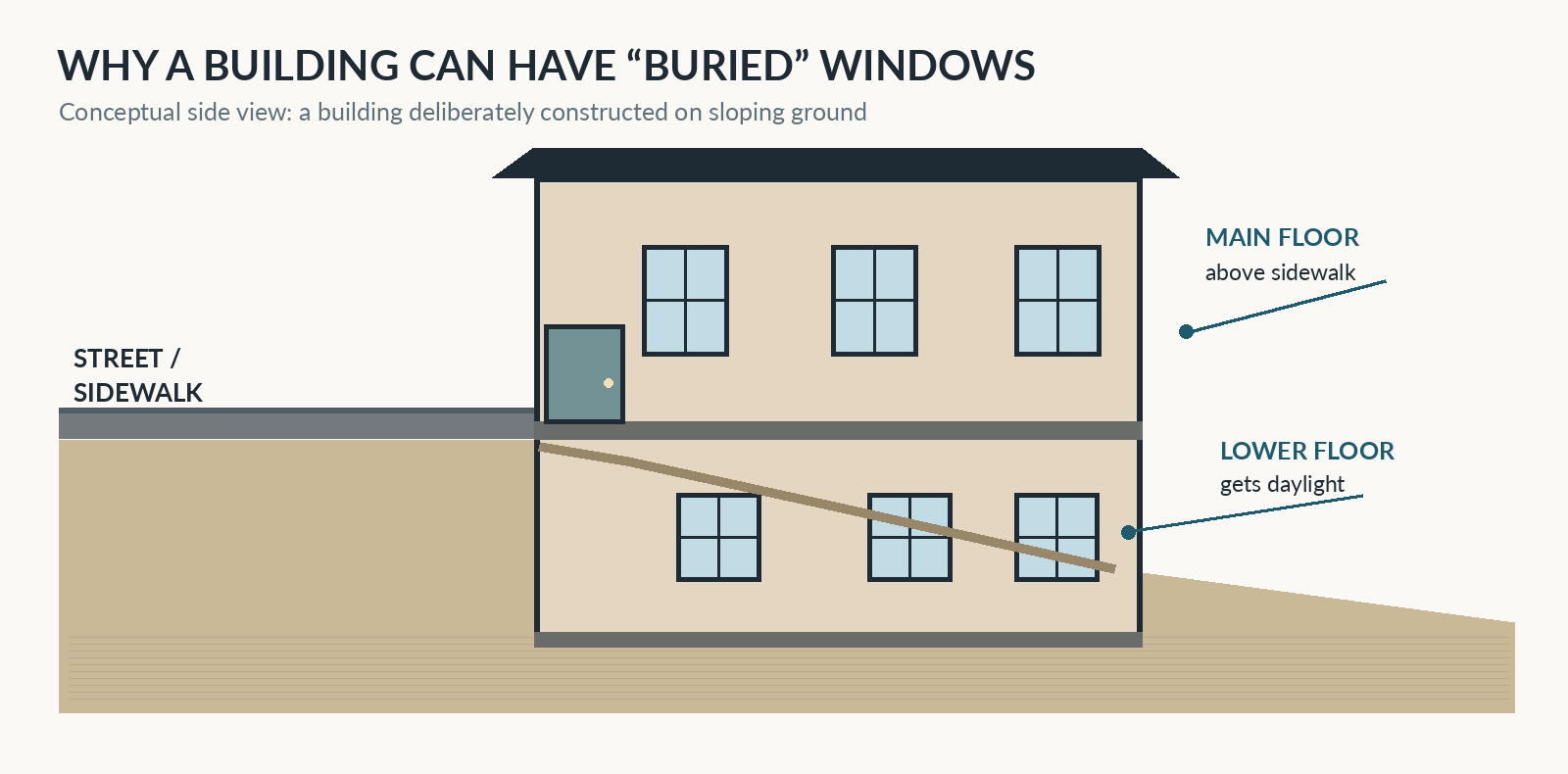
Figure 1. An explanatory cross-section of hillside construction. This is a schematic, not a drawing of the actual Athens warehouse.
Now consider the mud itself. If a flood deposited enough material to bury entire cities, where did the material come from? What carried it? Did it pass over the hill, around it, or down the surrounding valleys? And what happened to everything in its path?
Real mudflows can follow valleys, sweep around obstacles, carry boulders, and leave uneven deposits. They do not have to flatten the countryside or cause every rock to sink. But they leave physically identifiable sediments, damage patterns, and landforms that geologists can investigate. If the alleged catastrophe happened across much of the world only a couple of centuries ago, where is the corresponding widespread geological evidence? Where are the deposits that can be dated to the proposed event? [41]
And even if we find an old building whose street-level windows seem unusually low, shouldn't our first step be to look for its original building plans or records of changes in street elevation?
Chicago offers an extraordinary documented example. During the nineteenth century, engineers raised street grades by several feet to accommodate sewers and drainage. Some owners raised their buildings as well. The Chicago Public Library preserves the history of that construction and the reasons behind it. [40]
Trust me, I've heard the response when someone presents original architectural plans, engineering records, or municipal archives that contradict a mud-flood explanation.
Those records were fabricated.
And it doesn't stop with building plans. Consider the hundreds of thousands of surviving personal letters, including correspondence between soldiers and their families during the Revolutionary and Civil Wars. Consider ship logs, shipping records, family diaries, business correspondence, property deeds, church registers, census records, and court proceedings. The Library of Congress holds extensive family correspondence from the Civil War period. University libraries preserve thousands of actual letters and diaries. The National Archives holds naval deck logs reaching back to the Revolutionary War. These aren't simply modern textbooks describing what happened; many are documents written while those people were living their lives. [42]
But when those records conflict with the proposed reset?
You guessed it. All fake.
What would that explanation require? Independent families, businesses, military units, courts, churches, and governments across different generations and countries would somehow have to leave behind an enormous, mutually consistent collection of fabricated history.
And for what reason, exactly?
Was the supposed cover-up about power? Control? Keeping people ignorant of a former civilization? Power over whom, for what purpose, and with what demonstrable benefit? Who organized the effort, and what evidence shows it happened?
There's a distinction worth preserving: a theory isn't false merely because its current popularity began online. Real discoveries can emerge at any time. But what new physical evidence established this catastrophe? An old photograph doesn't become proof of a global mud flood simply because someone uploads it with a new explanation.
The age of an old photograph doesn't establish the age of the story someone attaches to it.
And declaring every contradictory record a forgery doesn't strengthen the claim. It makes the claim increasingly difficult to test.
If every piece of evidence against a theory is automatically explained away as part of the conspiracy, what evidence could ever demonstrate that the theory was wrong?
When an explanation can accommodate supporting evidence, contradictory evidence, and a complete absence of evidence equally well, what observation could ever show it to be mistaken?
Possibility is not probability, and neither is proof.
8. Contrails: Why Some Disappear and Others Linger
An aircraft passing overhead may leave a white trail that fades in seconds or lingers for hours, spreading into cirrus-like cloud. On social media, that ordinary difference is sometimes presented as evidence of “chemtrails,” a supposed secret spraying program. But the actual formation and persistence of contrails have long been studied.
Aircraft exhaust introduces water vapor and particles into very cold air. Under suitable conditions, ice crystals form. In comparatively dry upper-level air they evaporate or sublimate quickly. In ice-supersaturated air they can persist, grow, and spread with the winds. These processes have been studied for decades. H. Appleman published a detailed explanation of contrail-formation conditions in 1953, and visible aircraft trails were documented before that. [14]
Think of exhaust on a cold morning. Some days a visible plume seems to vanish almost at the tailpipe; other days it lingers. Or think of patchy fog: nearby pockets of air can have different temperature and moisture conditions. These are useful analogies, even though contrails are mainly ice crystals and fog is usually made of liquid droplets.
A peer-reviewed 2016 study led by non-government researchers asked 77 relevant atmospheric experts about the alleged secret, large-scale spraying program. Seventy-six reported finding no evidence of it; they identified conventional atmospheric and sampling explanations for the claims presented. A study is not a substitute for inspecting evidence, but it is worth noting that the allegation has been examined by people trained in the subject. [15]
If the Trails Were Deliberate, What Would They Accomplish?
As I was drafting this essay, there were contrails all over the sky above me. A cold front had just passed through, and no rain was forecast locally for several days. If I believed those trails were evidence of a secret spraying operation, I'd want to know something specific: What is the operation supposed to accomplish?
Is it meant to produce rain tonight, tomorrow, or next week? Change something else about the weather? Or is the claim that someone is releasing a mind-altering substance? If so, what measurable effect would we expect, and how would we distinguish it from ordinary variation in weather or behavior?
One rain-free week wouldn't rule out every imaginable claim. But an accusation of deliberate spraying needs a stated purpose, an observable predicted effect, and evidence connecting the aircraft to it. Seeing a trail is an observation. Assigning it a secret purpose requires evidence.
There is also a practical way to investigate what passes overhead. Public flight trackers can often identify a passenger jet, cargo aircraft, business jet, or another flight, sometimes showing its operator, origin, destination, altitude, and speed. Not every aircraft appears on every service, and a contrail may drift far from its original path. A tracker cannot determine exhaust chemistry, but it offers a concrete starting point for examining a specific claim. [16]
The allegation of a secret worldwide spraying program raises basic logistical questions. Which operators are supposedly involved: passenger airlines such as Delta or American, cargo carriers, private owners, military or government fleets? How would equipment be installed, chemicals supplied, and operations concealed from pilots, mechanics, airport workers, dispatchers, and contractors? Most importantly, what measurable evidence would distinguish such a program from normal engine exhaust and persistent ice-crystal contrails? Those are testable questions, unlike a vague assertion that a white trail must be suspicious.
9. Cloud Seeding Is Real. Hurricane Steering Is Another Claim.
I want to acknowledge something plainly: cloud seeding is real. The modern scientific era of cloud seeding began in 1946 with experiments at General Electric. It has since been openly studied and employed in efforts to influence precipitation under certain existing cloud conditions. This was never a secret discovered by a Facebook page. [17]
But the existence of cloud seeding does not establish the ability to manufacture or steer a hurricane toward a city. The United States even researched attempts to alter hurricanes through Project STORMFURY. That effort did not demonstrate a reliable means of weakening hurricanes and was discontinued. [18]
Here's where the evidence matters. Cloud seeding can influence precipitation in some suitable existing clouds; studies of particular winter-cloud seeding methods have demonstrated measurable effects. But that limited capability is not evidence that anyone can create, intensify, weaken, or steer hurricanes. The World Meteorological Organization's 2025 assessment says there is no generally accepted evidence that tropical cyclones can be modified. A historical 2010 statement from the American Meteorological Society, an independent professional society, likewise noted that proposed methods for steering or weakening tropical cyclones lacked an established physical basis. That particular statement is now archived and no longer in force. That is the distinction between a documented technique and an unsupported leap in what the technique can accomplish. [19]
Hurricanes existed centuries before aircraft. That historical fact establishes their natural occurrence, but by itself doesn't prove that a modern storm could never be influenced. For the present-day accusation, we need evidence of the claimed technology and its demonstrated effects. We also need to consider the already measurable winds and pressure systems that steer storms.
I have also heard the claim that governments intentionally intensify hurricanes or winter storms in order to gain “power.” That word is sometimes offered as though it settles the question. Power over whom? Power to do what? What, specifically, would they gain from that power? A policy change? Money? Control over land? Political leverage? Who receives the benefit, by what mechanism, and what evidence connects that benefit to the alleged manipulation of the storm?
Take Hurricane Helene in September 2024 and the devastation around Chimney Rock in western North Carolina. The state estimated about $59.6 billion in damage and recovery needs. By May 2026, federal recovery awards had reached approximately $8.3 billion, alongside substantial state appropriations. Those figures refer to different measures and should not be mistaken for a single bill, but they make clear the enormous public and private costs of the disaster. [20][21]
A government might do something harmful despite the costs, so those losses alone do not disprove intent. But they make a one-word explanation like “power” woefully incomplete. Communities were damaged, lives were disrupted, public agencies had to respond, and taxpayers helped fund recovery. If the accusation is that someone caused or worsened all that deliberately, then name the alleged actor, define the alleged benefit, explain the technology, and present the evidence. Otherwise “power” is not an explanation; it is a word used in place of one.
The fact that one limited technology is real doesn't make every extravagant claim about it real.
10. The Confidence of Not Knowing
Intelligence, education, knowledge, and humility are different things. An intelligent person can lack a formal education. A highly educated person can be uninformed outside a specialty. Every one of us is ignorant about countless subjects, myself included.
I don't need to know everything about astronomy, meteorology, archaeology, or photography to recognize that somebody else may have spent decades investigating a question I have only just encountered. Their degree or job title doesn't make them infallible. But neither does my lack of understanding make their findings false.
One of the most troubling habits I've observed is using our inability to explain something as evidence that it must be impossible. A photograph looks strange, so it was faked. A contrail persists, so it was sprayed. An ancient building is impressive, so it required lost supertechnology. An unfamiliar question is treated as a decisive accusation before anyone has investigated its answer.
Ignorance is not the failure to know. The more serious failure is refusing to learn while insisting that we already know.
11. The Mind of a Conspiracy Theorist: What Independent Studies Actually Show
The title isn't meant as an insult or a diagnosis. I don't believe there is one personality type that explains everyone who accepts a conspiracy theory. And I don't assume that every person who believes an extraordinary claim is unintelligent, dishonest, or unwilling to learn.
The psychological research doesn't support a single caricature of “the conspiracy believer.” A 2025 university-led meta-analysis covering 279 studies and more than 137,000 participants found that conspiracy beliefs were associated, on average, with motives involving explanation, security, and social identity. The relationships varied across studies and cannot diagnose any particular individual. [22]
Researchers have examined something particularly relevant to my experience: the appeal of feeling that one possesses special knowledge unavailable to most people. A 2017 series of university experiments, published under the title “I Know Things They Don't Know!”, found that conspiracy beliefs were associated with a desire to feel unique and with the feeling of having access to scarce information. A separate 2017 study, “Too Special to Be Duped,” reported a modest but consistent relationship between the need for uniqueness and conspiracy beliefs. These are independent studies, not government pronouncements. They suggest one possible attraction of certain narratives; they don't establish why any particular person believes them. [23][24]
That may help explain why the language of being “awake,” “enlightened,” or among the few who “know the truth” can be so appealing. Feeling as though one has discovered something most people missed can be satisfying. But the feeling of being unusually informed is not evidence that the information is correct. And the studies don't prove that every person attracted to a conspiracy theory refuses to examine contrary evidence.
The research points toward several possible motivations: a desire for answers when events feel confusing; a desire for security or control when the world feels threatening; and, for some people, the attraction of belonging to a group that seems to know something outsiders do not. None of those motivations proves a particular claim false. Nor do statistical associations establish the motives of someone I know personally.
But the studies give me a question worth asking myself as much as anyone else: Am I drawn to this explanation because it has survived serious examination, or because believing it makes me feel informed, reassured, special, or understood?
12. Feeling Right, Wanting to Be Right, and the Evidence We Avoid
A strong feeling is not a fact. I don't dismiss intuition; intuition may tell us something deserves a closer look. But intuition should start an investigation, not end one.
What I can speak to is a pattern in my own experience: people may spend hours reviewing material that reinforces a belief and very little time seriously investigating an explanation that challenges it. They may be completely sincere. I'm not saying they secretly know their claims are false. I'm saying sincerity and selective research can coexist.
Here is the double standard that has troubled me most. In my experience, some of the people who insist that I question everything I was taught become upset when I question the claims they have chosen to believe. They ask me to reconsider scientists, textbooks, and institutions, but seem reluctant to reconsider a video or creator they trust. They want openness from me while treating my questions as an insult to them.
I cannot speak for what every person feels, and I know that an argument can become unkind on either side. But if questioning is the standard, it has to apply in both directions. It cannot be a test only of whether I am willing to reconsider established science; it must also be a test of whether someone who disputes it will reconsider the claims they trust.
They taught you to question everything. But did they teach you to question yourself?
If I insist that an edited clip proves a conspiracy, then someone shows me the original recording, I should be interested in that correction. If I immediately search for another clip that lets me keep the same conclusion, I haven't really tested my belief.
We've all felt absolutely certain and later found out we were wrong. That's why this question matters: Do I know this because I examined the evidence, or does it simply feel right because it confirms something I already believed?
13. When Your Feed Becomes Your Reality
The word they becomes especially interesting when social media enters the picture. People who question what their teachers taught them may never ask how Facebook chooses what appears in their feeds.
Its systems consider many signals, including watch time, shares, followed accounts, and interactions. Meta openly describes these recommendation signals. A recommendation system predicts what might hold your attention; it is not a truth detector. [25] Whether this problem grows or recedes will depend partly on platform design, financial incentives, users' choices, and what researchers continue to learn. More exposure is not inevitable simply because social media exists.
Someone who repeatedly watches videos about hidden civilizations or secret weather programs may begin encountering more creators offering similar material. Their posts may have thousands of comments, including enthusiastic agreement and furious disagreement. Repeated exposure can make the subject feel ubiquitous and the claim feel established.
But five creators repeating one unsupported assertion are not five independent sources. And thousands of comments aren't a scientific experiment.
University researchers working with Meta data found that Facebook users were often exposed to like-minded sources. Their 2023 experiment also found that reducing such exposure did not measurably change the political attitudes they tested during the study. Algorithms affect exposure, but they do not single-handedly determine anyone's convictions. People's own preferences, communities, and choices matter too. [26]
That is another irony worth examining: a person can question what teachers and scientists said while placing remarkably little scrutiny on the personalized system selecting the next video, or on the creator who made it.
When We Ask AI to Agree With Us
Social media is not the only technology that can reinforce what we already believe. Artificial intelligence introduces another possibility: we can ask it to examine our thinking, or we can try to make it echo that thinking back to us.
Most people appreciate encouragement. There is nothing wrong with asking an AI assistant to be patient, kind, or emotionally supportive. But seeking emotional validation and seeking factual verification are two very different things.
I have personally witnessed frustration when an AI assistant challenged a conclusion someone already held. Rather than examining the objection, the response was to try to make the AI answer in a way that would better align with an established worldview. The issue was not merely tone. It was whether disagreement was welcome at all.
Imagine asking an AI to investigate whether a claim is true, but first instructing it not to consider evidence that contradicts what you already believe. Are you really investigating the claim, or have you simply built a more personalized echo chamber?
AI is not an unquestionable authority. It can be overly agreeable, misunderstand a question, make errors, or invent convincing-sounding information. Its answers should be examined against original records, testable observations, and credible sources. An AI response is not, by itself, proof.
But we still get to decide what we ask of it. We can say, “Show me the strongest evidence against my conclusion. What am I missing? What would change your assessment?” Or we can ask it to reassure us that our conclusion is already correct.
I would rather have an AI assistant explain why my reasoning may be flawed, with evidence I can check for myself, than have it enthusiastically agree with something that is not true. I do not need a machine to make me feel intelligent. I want it to help me become better informed.
If we deliberately limit the answers we are willing to hear, access to more information does not necessarily make us better informed. We may simply become more confident in what we already believe.
Validation can make us feel understood. But validation is not verification.
14. Communities, Belonging, and the Reward of Agreement
There's another side of this that isn't really about astronomy, archaeology, or meteorology at all: community. People want to belong. Most of us appreciate being surrounded by others who understand our interests and share our outlook. Online communities can provide genuine friendship, reassurance, and a sense of purpose.
Independent academic researchers have examined the role of social identity in conspiracy beliefs. A 2022 research review concluded that such narratives can serve needs for belonging, positive group identity, and security within a group. That doesn't mean every conspiracy community is identical, or that belonging is evidence a belief is mistaken. It means the social rewards of a shared worldview deserve attention. [27]
More strikingly, a 2023 independent experimental study involving 4,128 participants found that expected and received social engagement could influence the sharing of conspiracy claims. Under the study's conditions, some participants shared claims they knew were false when those claims offered greater social rewards, such as likes or reactions. That finding concerns sharing behavior, not proof that everyone who believes a conspiracy theory is knowingly deceptive. [28]
I can see why a community built around a shared sense of discovery might feel rewarding. Someone posts a video. Others say, “Exactly!” or “Finally, somebody gets it.” Agreement brings encouragement and a feeling of being understood. But an enthusiastic circle of agreement is not an independent test of the claim being discussed.
And what happens when someone in that circle asks an unwelcome question? Does curiosity remain welcome when it points away from the group's preferred explanation? Is disagreement treated as an opportunity to learn, or as evidence that someone doesn't belong?
These questions apply to more than conspiracy communities. Any group can mistake solidarity for evidence. Agreement can create belonging; it cannot, by itself, establish truth.
15. The Financial Side of Misinformation
This subject has become difficult for me to ignore on Facebook. Extraordinary claims often generate extraordinary engagement: views, comments, shares, outrage, and long arguments. Attention has economic value.
In March 2026, Meta reported paying Facebook creators nearly $3 billion during 2025 through its creator monetization programs. That number is not a count of payments for misinformation. It shows the enormous scale of the creator economy and its performance-based incentives. [29]
A 2024 Nature study led by researchers at Stanford and Carnegie Mellon documented how advertising helps finance websites that publish misinformation. Its findings concern websites and advertising networks, not proof that any specific Facebook creator is knowingly dishonest. [30]
Still, I have to wonder: how many creators earn attention by promoting a claim they don't even believe? I cannot know their motives from a view count. Some are sincere. Some may be mistaken. Some may knowingly manipulate material. But the possibility of financial gain creates a conflict worth examining.
A person can post an edited video, suggest that NASA has confessed to fraud, and profit from attention generated by both believers and critics. The creator may move on to the next post. Meanwhile, families and friends may continue arguing about the last one.
For some creators, an unresolved mystery may be more valuable than an accurate explanation.
16. The Cost to Good Relationships
This is where the issue becomes personal for me.
Imagine two people living happily together in a house that is unmistakably cream-colored. They both insist it is blue. Each morning they admire their beautiful blue house. A neighbor walks by and says, “You know it’s cream, right?” They laugh and shake their heads. “Poor guy. He obviously doesn't understand blue.”
Could those two people be perfectly happy agreeing with each other? Of course. Shared certainty can feel comforting, even intimate. But their agreement does not turn the house blue. The desire to connect with someone who sees the world the same way is not the same as a desire to be factually correct.
I didn't need a partner who agreed with me about every scientific or historical question. Flat Earth? Lizard people? Mud floods? Those differences, in themselves, weren't a reason I couldn't care deeply about someone. I could accept that a person I loved saw the world differently.
The real difficulty came when my own beliefs were treated as a deficiency. I wasn't merely someone who reached another conclusion; I was made to feel as though I was asleep, a sheep, or somehow less enlightened because I relied on physics, scientific evidence, independent research, and methods that can be tested. I didn't need someone to tell me I was right. I needed the freedom to disagree without having my judgment diminished.
I also recognize my own part in the arguments. I sometimes became defensive or frustrated, and there are conversations I could have handled with greater patience and care. When I felt disrespected, I sometimes thought the accusation had it exactly backward. Suddenly a disagreement about evidence became a painful contest over who was awake, who had been deceived, and whose judgment deserved respect.
In my experience, I could live with the difference in beliefs. What was far harder was the feeling that the person I loved wanted, or perhaps needed, me to share those beliefs to feel fully understood. I think we both tried to find common ground, but that proved difficult. That is my experience, not a claim about how every relationship involving conspiracy beliefs works.
Research supports taking the interpersonal cost seriously. Across seven studies involving 2,526 people, independent university researchers investigated relationships between perceptions of conspiracy beliefs and anticipated or reported relationship satisfaction, including the role of shared beliefs. These findings cannot explain any one relationship, but they show why differing beliefs and the meanings attached to them deserve careful attention. [31]
There's a difference between listening respectfully to someone and being required to agree that their claims are true. Two people should be able to say, “I hear you. I understand why this matters to you. I see the evidence differently,” without the disagreement becoming an insult.
The responsibility runs both ways. Scientific evidence should not be used as an excuse to belittle someone. Personal conviction should not be used as an excuse to call a partner ignorant or asleep. Being factually correct does not automatically make a conversation kind or productive.
This is one of the invisible costs of misleading content. The person who created a sensational video may collect another view or comment. People who encounter it may carry an argument into their homes and lose something much more valuable: peace, trust, and closeness.
I could accept the difference in what we believed. What became difficult was the judgment attached to my not believing the same things.
17. Free Expression and the Responsibility to Verify
I'm not advocating blanket censorship. Governments, universities, corporations, and scientists can make mistakes. Officials can lie. Scientific understanding changes when better evidence appears. Those are reasons to scrutinize claims, not to abandon scrutiny.
I do believe there's a meaningful difference between asking an unpopular question and knowingly misrepresenting an original recording. Between proposing a speculative hypothesis and presenting invented evidence as settled fact. Between making an honest mistake and repeatedly spreading a claim after learning that its central evidence was distorted.
Platforms can add context, link original sources, make monetization rules more transparent, and reduce incentives for demonstrably deceptive content while protecting legitimate disagreement and offering fair appeals. None of those approaches is effortless; deciding what is false can itself be contested. That is why transparency matters.
But we can't assign all responsibility to platforms. There is a personal responsibility too. Before sharing a dramatic clip, look for the full version. Before claiming a historical achievement never happened, check independent records. Before insisting that a natural phenomenon is impossible, learn the physics that supposedly makes it impossible.
A 2021 university-led study published in Nature found that simply directing people's attention toward accuracy improved the quality of information they were willing to share in the settings the researchers tested. [32] That is a modest but hopeful lesson: taking even a moment to ask “Is this accurate?” can matter.
Nobody can independently repeat every experiment. We all rely on testimony and expertise. But reliable knowledge can be checked through transparent methods, competing investigators, independent measurements, and successful predictions. The standard should not change just because a claim tells us what we want to hear.
18. So, What Happens Next?
When beliefs don't change, can respect still grow?
After all these examples, there is a difficult practical question: what happens when two people care about each other but disagree profoundly about what counts as reliable evidence?
Independent research suggests that deeply held conspiracy beliefs can be quite stable. A 2024 longitudinal study followed 498 adults in Australia and New Zealand over six months and found much more variation between people than change within individuals. Some participants changed their minds, but major shifts were uncommon during the period studied. The researchers cautioned that their sample may not represent people with especially strong conspiracy beliefs. [33]
A separate 2023 systematic review assessed 25 studies involving 7,179 participants and found that most tested interventions were ineffective at changing conspiracy beliefs. Some methods encouraging analytical thinking or teaching critical-thinking skills showed promise. These studies do not prove anyone is incapable of changing, nor do they tell us what a particular person will believe years from now. But they offer little reason to assume that one more argument, one more correction, or one more video will quickly transform an entrenched worldview. [34]
That makes me think differently about the future of relationships where beliefs diverge. Perhaps the question isn't always whether someone will change what they believe. Perhaps it's whether they can change what they require another person to believe in order to feel accepted.
I don't think love should demand intellectual surrender. Nor does caring about another person entitle me to lecture them every time we disagree. It ought to be possible to accept that two people will not arrive at the same conclusion, to stop treating disagreement as a measure of intelligence or loyalty, and to protect the kindness that made the relationship valuable in the first place.
The research tells us belief change may be difficult. It does not tell us that mutual respect is impossible. That part is a choice people must work out together.
Maybe the most meaningful change isn't agreeing about the world. Maybe it's no longer making agreement the price of being understood.
Conclusion: Did They Teach You?
So I want to finish where I started: with questions, not demands.
Who are they? And which specific person, institution, measurement, or claim are you accusing of deception?
Did they teach you that Earth is round? Did they explain the shadows, the changing sky, the sunsets, and the long Antarctic summer daylight? If not, have you investigated those explanations yourself?
Did they teach you why our atmosphere has pressure without a solid dome? Why Earth rotates without creating the chaos imagined in some viral videos?
Did they teach you why hurricanes follow large-scale winds, why they generally spin in opposite directions in the two hemispheres, and why they seldom form near the equator?
Did they teach you how GPS satellites transmit time and position information? Have you ever looked up when the International Space Station will pass overhead and watched for it?
Did they teach you why aircraft leave contrails, why some vanish, and why others linger? Did they tell you cloud seeding exists, or did someone online present that public technology as evidence of an entirely different power to steer hurricanes?
Did they teach you what advanced means in the history of civilizations? And if you're certain a prehistoric society possessed technology beyond ours, what archaeological evidence would establish it?
Did they teach you how an edited video can change the meaning of a real statement? How an algorithm can show you more of what already holds your attention? How a viral post can generate financial rewards even when the controversy is founded on a misunderstanding?
And now the questions I think matter most:
They taught you to question everything. But did they teach you to question yourself?
When was the last time you actively looked for evidence that might prove you wrong?
When a person you care about disagrees, can you respect that difference without requiring agreement as proof of love or understanding?
What evidence would genuinely change your mind?
Are you applying the same standard to the creator you follow as you apply to the scientists you reject?
Does your confidence come from the quality of the evidence, or from how deeply you feel that you must be right?
When you share a claim with people you care about, have you made a reasonable effort to establish that it's true?
I don't expect anyone to know everything. I don't expect anyone to accept an authority unquestioningly. And I don't need everyone to agree with me.
I do hope we can recover a little intellectual humility and a little kindness toward people who disagree. Because questioning everything only means something if we're willing to question the explanations we most want to believe.
So, one last time: What were you taught? What did you actually learn? And how did you determine that the person telling you it was all a lie deserves your trust more than the evidence you never examined?
The goal isn't to feel right. The goal is to find out what's true, even when the truth proves us wrong.
References and Source Notes
“(independent study)” identifies university-led or non-government research. It does not guarantee the study received no public funding or involved no government or platform collaboration. Government, museum, professional-society, and corporate records are labeled separately.
[1]Christopher A. Matthew, Eratosthenes and the Measurement of the Earth's Circumference (Oxford University Press, 2023). (independent scholarly analysis) https://doi.org/10.1093/oso/9780198874294.001.0001
[2]Australian Antarctic Program, “Sunlight Hours in Antarctica”; Antarctic Treaty Secretariat, “Tourism and Non-Governmental Activities.” (public observational and treaty records) https://www.antarctica.gov.au/about-antarctica/weather-and-climate/weather/sunlight-hours/ ; https://www.ats.aq/e/tourism.html
[3]NOAA National Weather Service, “Air Pressure.” (government educational source) https://www.noaa.gov/jetstream/atmosphere/air-pressure
[4]NOAA Atlantic Oceanographic and Meteorological Laboratory, “What Determines the Movement of Tropical Cyclones?” (government meteorological explanation) https://www.aoml.noaa.gov/hrd/tcfaq/E11.html
[5]Tyler W. Barbero, Michael M. Bell, Jan-Huey Chen, and Philip J. Klotzbach, “A Potential Vorticity Diagnosis of Tropical Cyclone Track Forecast Errors,” Journal of Advances in Modeling Earth Systems 16 (2024), e2023MS004008. (university-led, peer-reviewed study with a government research collaborator; not wholly independent) https://doi.org/10.1029/2023MS004008
[6]C.-P. Chang, C.-H. Liu, and H.-C. Kuo, “Typhoon Vamei: An Equatorial Tropical Cyclone Formation,” Geophysical Research Letters (2003). (independent study) https://doi.org/10.1029/2002GL016365
[7]NASA, “Global Positioning System (GPS),” and NIST, GPS positioning explanation. (government technical sources) https://www.nasa.gov/directorates/somd/space-communications-navigation-program/gps/ ; https://www.nist.gov/how-do-you-measure-it/how-do-you-measure-your-location-using-gps
[8]NASA, “Spot the Station.” (government observational tool; passes can be independently verified) https://www.nasa.gov/spot-the-station/
[9]Smithsonian National Air and Space Museum, “Apollo 17 Liftoff from Moon, December 14, 1972.” (museum historical record) https://www.si.edu/object/apollo-17-liftoff-moon-december-14-1972%3Ayt_9HQfauGJaTs
[10]Smithsonian National Air and Space Museum, “Flag Pole, Apollo,” technical description of the lunar flag assembly. (museum artifact record) https://www.si.edu/object/flag-pole-apollo%3Anasm_A19770570000
[11]University of Manchester / Jodrell Bank Observatory, “The Moon Landing and Jodrell Bank.” (independent university observatory record) https://www.jodrellbank.net/explore/stories/the-moon-landing-and-jodrell-bank/
[12]NASA, “Artemis II Crew News Conference,” September 24, 2025 (original conference recording, government primary source) https://www.youtube.com/watch?v=9mq_lb_SmKE ; Mustafa Gatollari, “Statements Made by Artemis II Astronaut Fuels Moon Landing Conspiracy,” Distractify, April 6, 2026 (independent reporting on the clip and context; not a scientific study) https://www.distractify.com/p/artemis-2-conspiracy
[13]UNESCO, “Archaeological Ruins at Moenjodaro”; Society for American Archaeology, 2022 letter concerning Ancient Apocalypse. (international heritage record; independent professional-association assessment) https://whc.unesco.org/en/list/138/ ; https://documents.saa.org/container/docs/default-source/doc-governmentaffairs/saa-letter-ancient-apocalypse.pdf
[14]H. Appleman, “The Formation of Exhaust Condensation Trails by Jet Aircraft,” Bulletin of the American Meteorological Society 34 (1953), 14-20. (peer-reviewed historical research; author was affiliated with the U.S. Air Weather Service, so not labeled independent) https://doi.org/10.1175/1520-0477-34.1.14
[15]Christine Shearer, Mick West, Ken Caldeira, and Steven J. Davis, “Quantifying Expert Consensus Against the Existence of a Secret, Large-Scale Atmospheric Spraying Program,” Environmental Research Letters 11 (2016). (independent study; the published corrigendum adjusted figure labels and other details without changing the 76-of-77 finding) https://doi.org/10.1088/1748-9326/11/8/084011
[16]Flightradar24, “How Flightradar24 Works.” (private flight-data provider describing its tracking methods, not a scientific study) https://data.flightradar24.com/how-it-works
[17]American Meteorological Society, “100 Years of Progress in Applied Meteorology. Part I: Basic Applications,” section on weather-modification history; Adelaide Mandeville, “Man-Made Weather: The Promise, Peril, and Uncertainty of Cloud Seeding in Postwar America,” Environmental History (2025). (scholarly historical sources; the meteorology review is not categorized here as a wholly independent study) https://journals.ametsoc.org/abstract/journals/amsm/59/1/amsmonographs-d-18-0004.1.xml ; https://doi.org/10.1086/736092
[18]NOAA, Project STORMFURY historical account. (government program history) https://www.aoml.noaa.gov/hrd/hrd_sub/sfury.html
[19]World Meteorological Organization, “WMO Statement on Weather Modification,” issued 2025 (international scientific assessment, not an independent university study), https://wmo.int/content/wmo-statement-weather-modification ; American Meteorological Society, “Planned Weather Modification through Cloud Seeding” (historical 2010 independent professional-society statement, archived and no longer in force; not an experimental study), https://www.ametsoc.org/ams/about-ams/ams-statements/archive-statements-of-the-ams/planned-weather-modification-through-cloud-seeding/
[20]State of North Carolina, Hurricane Helene State Action Plan, quantified damage and recovery-needs assessment, based on December 13, 2024 estimates. (state government assessment; not an independent study) https://www.commercerecovery.nc.gov/plans-policies-and-reports/hurricane-helene/state-north-carolina-action-plan
[21]North Carolina Governor’s Office, “In DC, Governor Stein Shares Updates on Helene Recovery,” June 10, 2026 (federal awards and state appropriations). (state government funding report; not an independent study) https://governor.nc.gov/news/press-releases/2026/06/10/dc-governor-stein-shares-updates-helene-recovery-and-calls-congress-invest-western-north-carolina
[22]Mikey Biddlestone et al., “Reasons to Believe: A Systematic Review and Meta-Analytic Synthesis of the Motives Associated With Conspiracy Beliefs,” Psychological Bulletin 151 (2025), 48-87. (independent study) https://doi.org/10.1037/bul0000463
[23]Anthony Lantian, Dominique Muller, Cécile Nurra, and Karen M. Douglas, “I Know Things They Don’t Know! The Role of Need for Uniqueness in Belief in Conspiracy Theories,” Social Psychology 48 (2017), 160-173. (independent study; university psychology research) https://doi.org/10.1027/1864-9335/a000306
[24]Roland Imhoff and Pia Karoline Lamberty, “Too Special to Be Duped: Need for Uniqueness Motivates Conspiracy Beliefs,” European Journal of Social Psychology 47 (2017), 724-734. (independent study; university psychology research) https://doi.org/10.1002/ejsp.2265
[25]Meta, “How AI Influences What You See on Facebook and Instagram,” June 2023. (platform's own description, not an independent study) https://about.fb.com/news/2023/06/how-ai-ranks-content-on-facebook-and-instagram/
[26]Brendan Nyhan et al., “Like-Minded Sources on Facebook Are Prevalent but Not Polarizing,” Nature 620 (2023), 137-144. (academic study conducted with Meta cooperation and platform data; academic authors retained editorial discretion; not wholly independent of platform participation) https://doi.org/10.1038/s41586-023-06297-w
[27]Claire E. Robertson, Clara Pretus, Steve Rathje, Elizabeth A. Harris, and Jay J. Van Bavel, “How Social Identity Shapes Conspiratorial Belief,” Current Opinion in Psychology 47 (2022), 101423. (independent academic research review; not a controlled experiment) https://doi.org/10.1016/j.copsyc.2022.101423
[28]Zhiying (Bella) Ren, Eugen Dimant, and Maurice Schweitzer, “Beyond Belief: How Social Engagement Motives Influence the Spread of Conspiracy Theories,” Journal of Experimental Social Psychology 104 (2023), 104421. (independent study; university-led experiments, N = 4,128) https://doi.org/10.1016/j.jesp.2022.104421
[29]Meta, “Creator Fast Track: A New Way to Quickly Grow Your Audience and Earn Money on Facebook,” March 2026. (company-reported payout figures, not an independent study) https://about.fb.com/news/2026/03/creator-fast-track-grow-your-audience-earn-money-on-facebook/
[30]Wajeeha Ahmad et al., “Companies Inadvertently Fund Online Misinformation Despite Consumer Backlash,” Nature 630 (2024), 123-131. (independent study) https://doi.org/10.1038/s41586-024-07404-1
[31]Daniel Toribio-Flórez, Ricky Green, and Karen Douglas, “Belief in Conspiracy Theories and Satisfaction in Interpersonal Relationships,” Journal of Applied Social Psychology 54 (2024), 603-627. (independent study) https://doi.org/10.1111/jasp.13061
[32]Gordon Pennycook et al., “Shifting Attention to Accuracy Can Reduce Misinformation Online,” Nature 592 (2021), 590-595. (independent study) https://doi.org/10.1038/s41586-021-03344-2
[33]Matt N. Williams et al., “People Do Change Their Beliefs About Conspiracy Theories, but Not Often,” Scientific Reports 14 (2024), 3836. (independent study; longitudinal survey of 498 adults over six months) https://doi.org/10.1038/s41598-024-51653-z
[34]Cian O’Mahony, Maryanne Brassil, Gillian Murphy, and Conor Linehan, “The Efficacy of Interventions in Reducing Belief in Conspiracy Theories: A Systematic Review,” PLOS ONE 18 (2023), e0280902. (independent study; review of 25 studies, N = 7,179) https://doi.org/10.1371/journal.pone.0280902
[35]Charles J. Halperin, “False Identity and Multiple Identities in Russian History: The Mongol Empire and Ivan the Terrible,” The Carl Beck Papers in Russian and East European Studies 2103 (2011), discussion of Fomenko and Nosovskii's New Chronology. (independent scholarly historical analysis) https://doi.org/10.5195/cbp.2011.160
[36]Brian Dunning, “Tartaria and the Mud Flood,” Skeptoid, episode 765, February 2, 2021; Australian Associated Press, “Ancient Empire's Link to Historic Buildings Is a Delusion” (2024). (independent science commentary and independent fact-check reporting; neither is a primary archaeological study) https://skeptoid.com/episodes/4765 ; https://prod-ss.aap.com.au/factcheck/ancient-empires-link-to-historic-buildings-is-a-delusion/
[37]KorbenDallas, “Tartary - an Empire Hidden in History. It Was Bigger than Russia Once,” StolenHistory.org, April 17, 2018 (archived original online forum post); Lead Stories, “Declassified 1957 CIA File Mentioning 'Tartar History' Does Not Vindicate Tartarian Empire Conspiracy Theory,” April 2024 (secondary verification of post and date). https://web.archive.org/web/20180419121532/https://www.stolenhistory.org/threads/tartary-an-empire-hidden-in-history-it-was-bigger-than-russia-once.40/ ; https://leadstories.com/hoax-alert/2024/04/fact-check-declassified-1957-cia-file-mentioning-tartar-history-is-not-related-to-tartarian-empire-conspiracy-theory.html
[38]Amelia Raines, “Tracking 'Tartary' on Western Maps,” Library of Congress, June 20, 2025; Guillaume de L'Isle, Carte de Tartarie (1706), Library of Congress Geography and Map Division, item 99446168. (government archival interpretation and primary historical map) https://blogs.loc.gov/maps/2025/06/tracking-tartary-on-western-maps/ ; https://www.loc.gov/item/99446168/
[39]Unified Government of Athens-Clarke County, Planning Department and Historic Preservation Commission, Downtown Athens Local Historic District: Local Historic Property Designation Report, p. 2, entries for F. M. Coker Cotton Warehouse and Athens City Hall. (local government primary preservation record) https://www.accgov.com/DocumentCenter/View/63791/Downtown-DesigRep-w-East-Amendments-Draft?bidId=
[40]Chicago Public Library, “Chicago Sewers Collection,” description of Ellis Chesbrough's sewer plan and the raising of Chicago's streets and buildings in the 1850s. (municipal archive collection and historical documentation) https://www.chipublib.org/fa-chicago-sewers-collection/
[41]U.S. Geological Survey, “Debris-Flow Hazards in the United States,” Fact Sheet 176-97; USGS, “Debris Flow or Flood?”, Fact Sheet 2004-3142. (government geological research and field guidance) https://pubs.usgs.gov/fs/fs-176-97/fs-176-97.html ; https://pubs.usgs.gov/fs/2004/3142/pdf/fs2004-3142.pdf
[42]Library of Congress, “American Women: Resources from the Manuscript Collections - Civil War”; Ohio University Libraries, “Civil War Correspondence”; National Archives, “Logbooks of the US Navy at the National Archives.” (primary-source collection guides, preserved letters and logs; not individual scientific studies) https://guides.loc.gov/american-women-manuscript/military-and-diplomatic-affairs/civil-war ; https://www.ohio.edu/library/digital-collections/digital-archives/civil-war-correspondence ; https://www.archives.gov/research/military/logbooks/navy